

In a previous post, I wrote about the power of stories in our lives and how they can be particularly helpful for children as they grow, learn and understand the world.
When children know a story inside-out, it becomes a template for their own creativity. And the amount of learning leverage you get from one single, well-known, well-loved story can be endless, which is why I love using them as a home ed parent.
In this post, I share some practical ways to use stories to help children build ideas, orally retell stories and ultimately develop their own creative writing.
Before Writing, Comes Ideas
I've seen how when children spend time hearing stories aloud, retelling them in their own words and playing with ideas and language, they naturally start to build the foundations for writing.
This creates a library of ideas in their mind, as well as vocabulary and language, that they can draw from later as they write.
And this follows a pattern we see in almost every area of learning.
From Imitation to Creativity
Learning any new skill tends to follow a natural arc:
- 1. Imitation: Being exposed to the skill regularly, like babies picking up words from just being around people speaking, not being specifically 'taught.'
- 2. Mastery: Learning the complexities of a skill and becoming more confident and competent.
- 3. Creativity & Originality: Using that knowledge to create something new and original.
The journey from knowing stories to writing them illustrates this progression perfectly.
Step 1: Imitation - Getting to Know a Story Well
Those kids who ask for the same story over and over again are developing powerful skills beneath the surface. When they know a story off-by-heart, whether it's a classic one that you (or they) have made up, it helps them notice patterns, remember sequences and develop their own narrative skills.
In fact, research shows that a child's oral storytelling ability predicts later reading and writing success.
From an early age, this can begin with short stories and simple recounts, all built around the core elements of stories:
Beginning → Character with a goal → Problem/Challenge → Resolution
Here are a few easy ways to bring this into everyday life:
- Short, simple stories: Start with well-loved fairy tales and picture books for younger children, or fables and myths for older ones. Familiarity is key. (See resources at the bottom for some help with this)
- Recounts & Narrations: Share stories from your own life, such as funny memories, incidents or even simple daily events and encourage your child to retell their own. Even small events have a beginning, middle and end.
- Simple observations: Model storytelling yourself (again see resources below for helpful books on this). It doesn't have to be elaborate, maybe just noticing the sneaky squirrel stealing nuts from the bird table, creating a story about his secret plans. (I used to put pressure on myself to make up big, exciting stories but the simpler ones were enjoyed just as much, and far easier to make up!)
- Short extracts for older kids: Once they know the basics of a story, you can explore extracts of longer favourites such as Harry Potter or Narnia, or any story your child loves. Even a short extract reveals how characters change and make choices, how tension builds and how themes emerge.
Over time, children begin to internalise these patterns. When they come to write for themselves, they’re drawing on something already very familiar rather than starting from scratch.
Step 2: Mastery - Retelling a story
Once a child knows a story really well, they can start to retell it in their own words. This gives them the chance to hold them, shape them and retell them, whether through spoken word, or even through signing for non-verbal children, which gives them a mental map they can draw upon later.
Here are some activities I've used over the years for retelling stories.
- 🔔 Create actions and sounds for the different parts: This is a fun way to remember the story. You can read the story aloud and have the children act out different parts as you read it eg. sounds for the weather, repeating the speech, funny actions etc. After a few times doing this, the actions will help to prompt their memory when they retell it.
- 🎭 Props: Create lolly-stick characters or use toys or puppets to bring the stories to life.
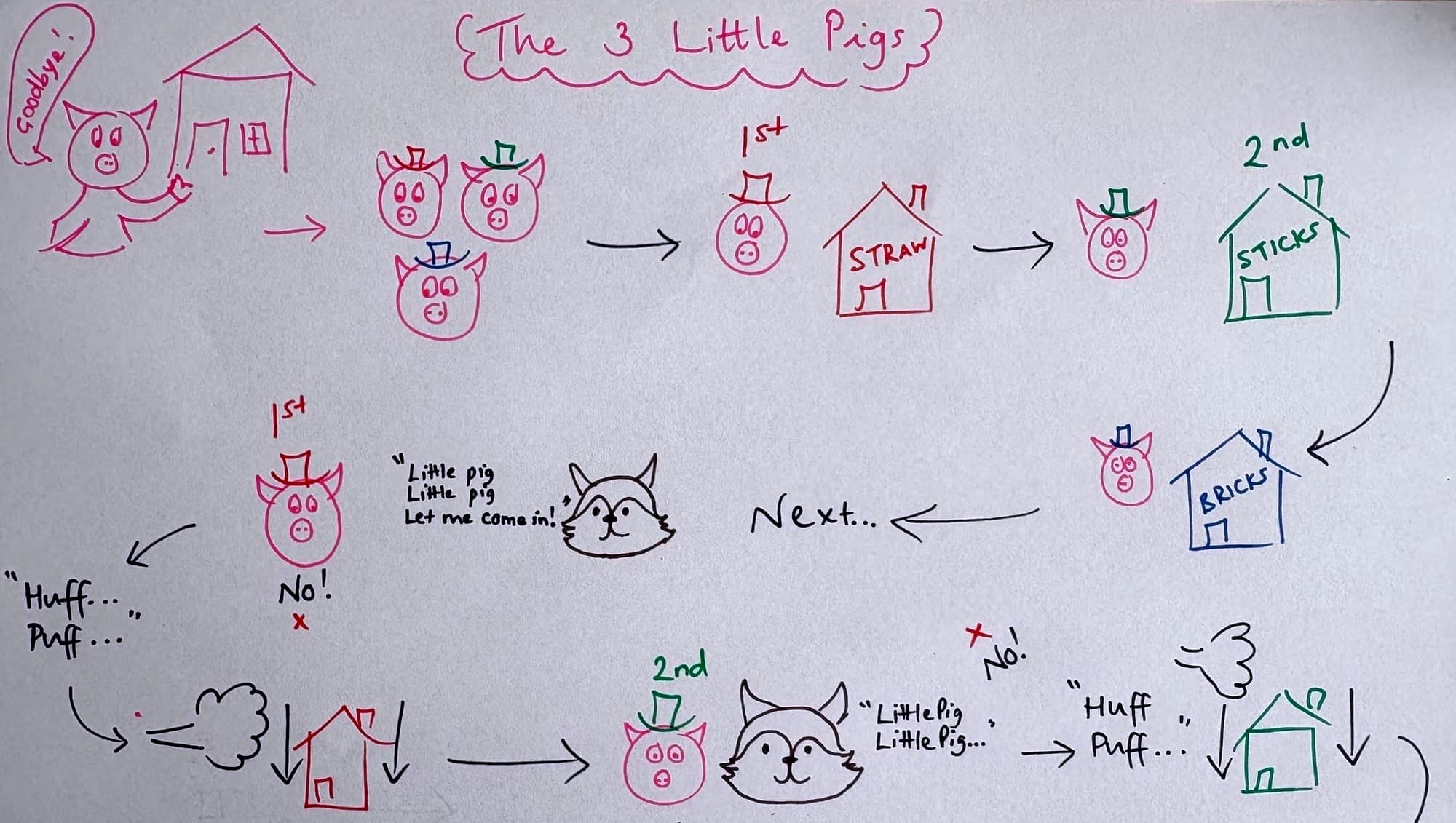
- 🖼️ Story maps, cartoon strips and picture prompts: It can be hard to remember the events of a story so having pictures with prompt words helps it along. One idea is to draw a story map together of each part of the story. For older kids, word or sentence prompts or a cartoon-strip style work well too. Below is an example of part of a story map for The 3 Little Pigs - just so you get the idea:
- 🍿 Make it a performance: If your child likes to perform, they can find or make some props and costumes to retell it in a theatrical style - see if you can grab some neighbours or friends to perform to.
👥 These activities can be such a lovely thing to do as a group, getting together with other families to learn the story, retell it and maybe even put on a performance at the end.
There’s no time limit to how long this can take, and it’s definitely not something to be rushed. Some children take longer than others to remember a story well, but the process of holding it in their minds is powerful in itself.
Having even just a few well-known stories up their sleeve gives them ideas to draw upon when it comes to their own creative writing.
✏️ Writing Activity Tip: Once a child knows a simple story well, they can try writing it down in their own words. You can create a special notebook for this where they'll have a lovely record of the stories they've learnt or created.
Here are some different options for writing it down depending on their level of confidence with writing:
- Not yet writing: You can write down what they say and keep it in their notebook, they could also illustrate it if they wanted to.
- Early Writers: You can write down their retelling in their own words for them to copy.
- Middle Writers: You can write down their retelling in their own words and dictate it back for them to write down.
- Confident Writers: They write their own retelling from memory, using prompts/story maps as well as word lists to guide them.
Step 3: Creativity & Originality - Writing a New Story
This is where strong familiarity turns into originality. Once a child has internalised the structure, characters and patterns of a well-loved story, they have a framework to build from.
There are lots of ways to add variation and create something new. Any well-known story works and can be adapted for all ages.
Start with very small changes for young kids, building up to complex plot twists and changes to time and settings for older kids.
Here are some examples from well-known tales:
Change characters
- Instead of The Three Little Pigs with a Big Bad Wolf, how about The 3 Little Wolves with a Big Bad Pig?
- In Little Red Riding Hood, the wolf is actually protecting the forest from flower pickers and Little Red Riding Hood is a culprit!
Merge two well-known stories
- Little Red Riding Hood + Hansel and Gretel - The woods are full of predators and the children join together to take them on.
Twist the plot
- In The Tortoise and the Hare, what if the hare puts on the race on purpose to teach the tortoise confidence, but now the tortoise has become arrogant.
- In Theseus and the Minotaur, the Minotaur is not a monster, he's actually guarding something dangerous in the labyrinth that must never be found, but Theseus doesn't know!
New settings, times and scenarios (great for older kids)
- (A little darker) A twist on The Three Little Pigs, three siblings build homes in different climate zones - flood, fire and storm - testing which design will survive extreme weather.
- Anansi the Trickster uses his tricks to expose corruption of global corporations and redistribute resources fairly.
There's no end to the new stories that can be created from old ones. These changes are the start of a new story that your child has created and is a chance to stretch their imagination while leaning on what they already know.
And they don't have to write them if they're not ready yet. Images, oral retellings, dramatised or cartoon versions all work really well.
✏️ Writing Activity Idea: Have them write out their new version of the story. They could make it into a book, illustrate it, turn it into stop-motion or act it out to perform.
Use the same approach for early, middle and confident writers from earlier.
One Story, Many Skills
One story can cover weeks of learning and include so many skills and other subjects within it.
In further posts, I'll share practical ways to use stories for:
- Reading comprehension
- Spelling and Grammar
- Linking to other subjects such as History and Art
A single story, known really well, can become a foundation not just for writing, but for learning across so many different areas.
Final Thoughts
When children internalise the rhythms and patterns of well-loved stories, they carry those structures within them. Their writing then becomes less about inventing something from nothing (an incredibly daunting task), and more about reshaping something they've already heard, told and played with.
Stories become frameworks for thinking, speaking and creating.
Related posts:
Reading Comprehension for Kids: Why It Matters and Simple Ways to Build It.
More Than Just Bedtime Tales: How Stories Help Children Learn & Grow
Useful Resources
📚 Good books for short well-known stories
Any short tale works well, such as fairytales, myths and fables. If you need some inspiration for short stories to use, here are a few books I've enjoyed for retellings over the years:
Mythopedia: An Encyclopedia of Mythical Beasts and Their Magical Tales by Good Wives and Warriors - a beautifully illustrated book of tales from around the world.
Aesop's Fables by Usborne
Homer's Iliad & Odyssey by Gillian Cross - a really good children's version of Homer's classics, split into short chapters. Great for retelling Ancient Greek myths.
Anansi the Trickster Spider by Lynne Garner
How Rabbit Stole the Fire - still one of my favourite stories to retell, which I did with my Year 2 class and again with my own children.
Reference Books
These are two well-loved books for parents & teachers to guide storytelling:
Pi Corbett - The Bumper Book of Storytelling. Pi Corbett is a master storyteller and passionate about children learning literacy skills through stories.This book is very easy to follow with stories, ideas for activities and resources - especially great for parents who aren't confident with storytelling activities.
Healing Stories for Challenging Behaviour by Susan Perrow - a brilliant book full of short stories for different scenarios, which also work well for retellings. Perrow also has lots of advice and tips for storytelling.