

The plan I share below is the only way of planning our day that's actually stuck!
It works because it’s visible to all of us which takes the pressure off me and makes the day feel more shared, something we’re doing together.
Why a Plan can Really Help
If I don't plan things in, they don't get done. It's as simple as that. Even the good stuff. In fact, especially the good stuff..
I've tried firm plans, I've tried no plans. Neither work for us. If they're too rigid, it feels like we can't be spontaneous and open to how we actually feel that day. If they're too loose, they can end up feeling flat by 10am.
The way we plan our day now makes space for structure and spontaneity - and the best part is that we do it together, so we all get our needs met and decide what we'd like to do that day.
I want to make clear, this is done in a very loose way. It takes less than 5 minutes, we usually do it over breakfast on a big whiteboard so everyone can see it.
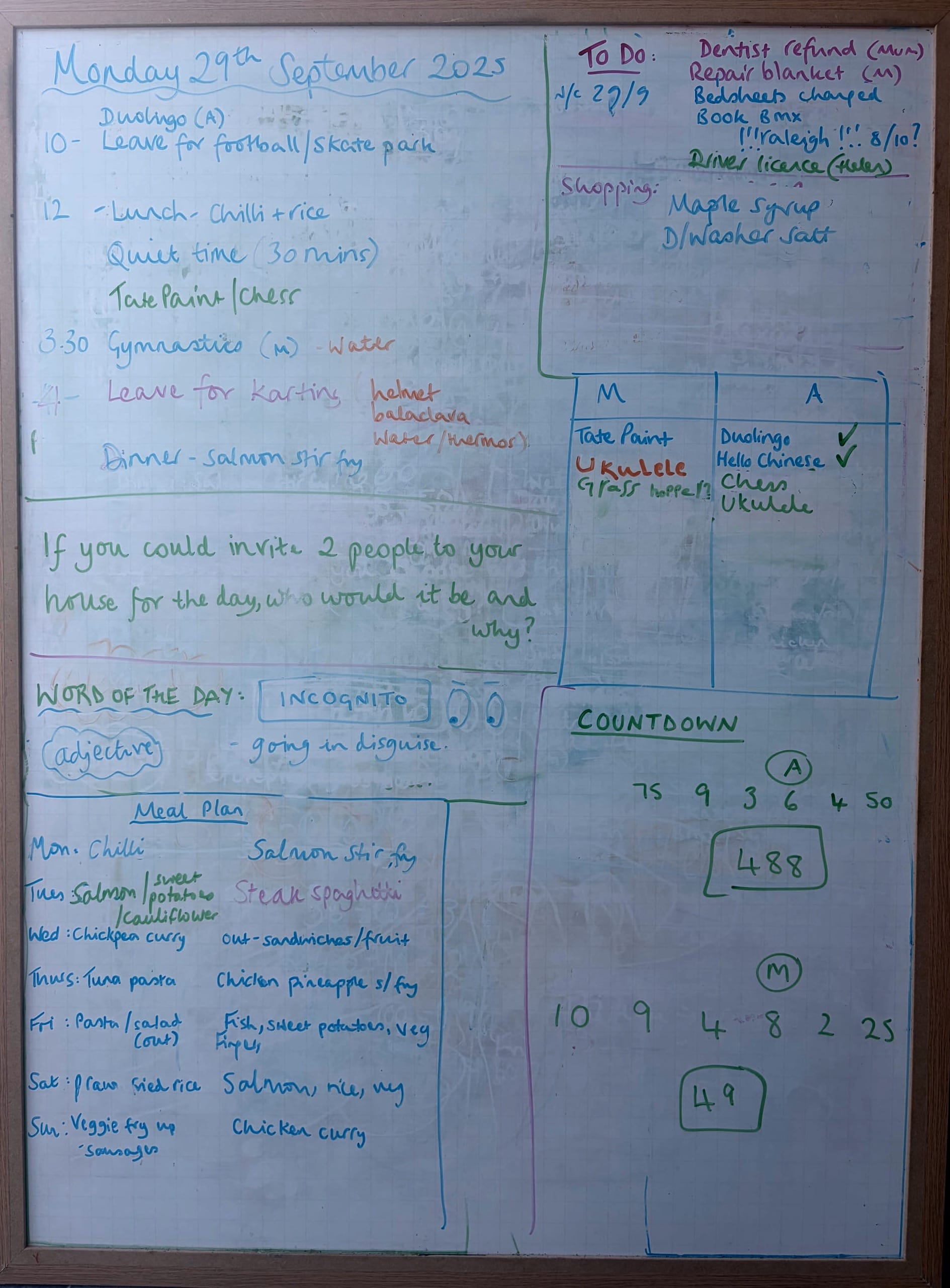
Here's ours from yesterday. As you can see, it doesn't need to be fancy, it just needs to actually work - which it does! (Apologies for the poor quality, but well..that's how it looks!)
1. The “Rocks, Pebbles, Sand and Water” Approach
This is the best analogy to describe how it works:
🪨 Rocks: These are the non-negotiables like appointments, essential tasks, commitments. Things that have to happen.
💎 Pebbles: These are the things we need to happen - daily learning activities or practice, clubs and activities, quiet times, time outdoors, chores.
⏳ Sand: These are the things that we really want in our day - unplanned activities, playdates, trips, creative activities, connecting activities.
🌊 Water: These are the 'nice to haves' - adventures, movies, dance parties, baking.
It will look different for everyone based on your priorities. Meeting friends and creative activities might be your rocks and house chores your water!
The idea is that if you map out your day loosely in this way, everything gets planned in. If you only plan in the non-negotiables, it's easy for the more creative and fun stuff to just not happen.
2. Making Sure Everyone's Needs are Met
Everyone in the family is included in this; their rocks as well as their sand and water.
The kids jot down anything they want to do; baking, learn about something specific, a game they want to play or somewhere they'd like to go. My husband and I will add anything for us as well. It helps make sure everyone’s needs and choices are heard - and yes, it fills up quickly!
On tough days when I'm feeling pulled in all directions, I might plan in something as specific as '20 minutes in the garden alone with a cup of tea.' 🫖
It also helps me prepare - like when one of the kids wants to do something creative or a bit chaotic. If it's loosely planned in, it’s more likely to happen than if it's sprung on me at 5pm while I’m cooking dinner (and I’m left feeling guilty for saying no).
3. The Vague Timeline & Running To-Do List
We write down a very vague timeline for the day - it doesn't have to be specific.
Alongside this is a running to-do list. It's where we capture all the little things that pop up - household chores, meal plans and errands. Keeping it visible for everyone means it's not all in one person's head and others can help out with different things that need doing.
For example, if the kids want me to join in with something but I have a few quick jobs first, they're much more likely to offer help when they can see what’s on the list, rather than me just saying, “I’ve got things to do first.” (And if they don't offer help, they can at least see that I'm not available for a while!)
It’s a small tweak, but it’s made our days feel a lot more cooperative.
Why this works
👍 Everyone feels valued. The kids get autonomy and choice, instead of having everything decided for them.
👍 Modelling self-care. They see us prioritising wellbeing and balance - planning isn’t just for the serious stuff, it’s a life skill.
👍 Structure without rigidity. It's a flexible framework with anchor points, but things can move or be dropped entirely.
👍 Feels like a win. Our days just flow better with a loose plan. Without one, even simple tasks seem to take more effort. Of course, some days are good for doing nothing at all and some days turn into total chaos - but having a rough plan mapped out does help things run more smoothly.
👍 Getting things done! Even if the “doing” is just tea and board games, it’s satisfying to have a sense of purpose or connection.
👍 Reduced Mental Load: As a forgetful person, writing things down - especially meals and chores - is a lifesaver and makes it easier for others to jump in and help.
There’s no right or wrong way to do this. Some days, the plan barely has anything on it and if we're out the door early then we don't tend to do it - but it's there as and when we need it and helps everyone feel involved in what’s happening.
It’s the longest-running plan we’ve ever used - and I’ve tried plenty! It’s flexible, quick to set up, easy to add to throughout the day and helps everyone in the family get what they need. An added bonus is that getting your kids involved helps build reading, writing and organisation skills naturally - without any pressure.
📅 How do you plan your days? Do you like things to be timed by the hour or do you completely go with the flow? Or somewhere in between? I always love hearing from you! Email me at jo@thehomeedhelp.com.