

I honestly think - and I'd like to actually check this one day - that you could cover about 60 - 70% of the primary national curriculum objectives through games alone. This may not be important to you at all, but if it is, the skills and knowledge your kids will pick up through playing games will amaze you. Some games have taught my kids skills that would have taken many lessons to work through in school.
Word games are particularly great. They're simple, quick, easy to adapt from very basic to ultimate challenge level and are just pretty fun. Language is naturally creative, and when kids can explore it playfully, they absorb loads of literacy skills without even realising it.
The games below are simple (you've probably even played most of them before), easy enough to do anywhere, only require a pencil and some paper and can be modified by ability and topic. And played regularly, they teach so many literacy skills. Just don't introduce them like a lesson - it'll ruin them completely. They're best done casually at meal times, travelling or during a lull in the day.
Hangman!
__ __ __ / __ __ __ __ / __ __ / __ __ __ __ ☃️
Not much to say about this other than some people, quite understandably, now prefer not to hang a man from a noose and instead make a snowman or monster!
You can play this with very little children and have basic 3 and 4 letter words and then build up to longer words and sentences. It stands the test of time and can be used to introduce new words, practise tricky ones or be linked to a topic or area of interest. Sometimes I start the day with a massive message to the kids on the whiteboard in the kitchen for them to decipher over breakfast (yes, we have a whiteboard - they're brilliant for SO MANY THINGS!).
Countdown
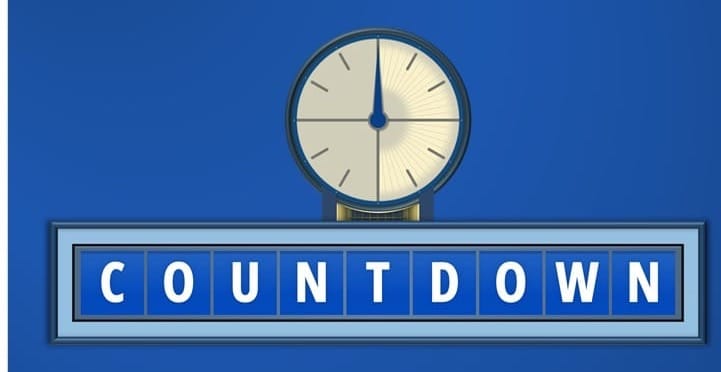
This is one of our most used games - it works great on a whiteboard but pen and paper's fine too.
For the Countdown word game, write down the vowels and consonants or use letter cards or Scrabble tiles. Challenge kids to pick up to 9 letters (they’ll quickly learn that a balance of vowels and consonants is key) and they try to make the longest word possible using those letters. If your kids like the pressure (mine definitely do not!) you could use the actual 30 seconds Countdown timer, available on YouTube.
Anagrams
Unscramble games are a great way for kids to play with words and letters without any pressure. You just give them a jumble of letters—like cautioned—and they try to figure out what word it makes when unscrambled. It naturally helps with spelling, pattern spotting and language confidence - but it can be tricky, especially for beginner readers so keep it simple. Write a few down on paper or a whiteboard - it's great to use a theme they're interested in - or leave them a secret note with scrambled words.
(The unscrambled word is 'education' if you hadn't worked that one out 😉)
Constantinople
I'm not sure if this is the official name but it'll do. It's where you have a long word, like Constantinople(!), or banana, or dinosaur - whatever your kids are interested in (or even what's on their particular year's vocab list if you're keeping pace with school). Then find as many words as possible within that one word either using each letter once or multiple times.
So for Constantinople using them only once, you could have pole, post, stain, consonant...
Using them more than once you could make pantaloons, toiletpan, constipation...
I used to play this a lot with my class, it would be on the board as they were arriving and we'd challenge ourselves each day to beat the previous day's score. You can also gamify it by assigning point scores based on the length of the word - this all depends on how much your kids like the competitive element though!
Silly Sentence Switch
This one can get silly but it teaches so much about basic grammar and sentence structure without touching a grammar book. And if you're not fussed about having your kids learn grammar at a young age, then it's just a fun game to play anyway.
Have a simple sentence like 'The ginger cat sat sleepily on the mat' - or even more basic for very young kids. Take it in turns to change one word in the previous sentence:
The noun (cat, mat), the verb (sat), the adjective (grumpy) or the adverb (sleepily).
When you pass it on, you have to tell the next person which of these words to change:
So changing the verb it might become: 'The ginger cat farted sleepily on the mat.'
They then pass this on and might say 'adjective', so it could become: 'The grumpy cat farted sleepily on the mat.'
And so on.
BAM - that'll tick off some of your National Curriculum objectives in no time if that's what you're after! But it will also be fun, silly (if your kids are anything like mine, poo and farts will make a regular appearance) and will build knowledge and confidence. Make it harder by making it rhyme or adding conjunctions (if, because, although).
And don't be afraid to use the proper grammatical words, just don't do it in a 'teacher-y' way. Use them casually, they're just words after all, it doesn't matter if they don't really understand them right now. Using them this way means they become less scary and just part of everyday language.
Why these games are so great:
✏️ They can be done ANYWHERE, you might just need a pencil.
✏️ They teach spelling, vocab and grammar without being boring. I wouldn't recommend bringing grammar to young kids unless it's done in a fun, non-pressured way - it's a sure way to kill the joy of reading and writing!
✏️ They're fun, they're interactive, they're connecting and there’s no pressure to get things 'right.'
✏️ They help with creativity and confidence - playing around with language makes it fun and mistakes seem less scary than on a worksheet or workbook.
✏️ They're naturally repetitive so it reinforces things easily.
✏️ They involve problem solving, logic, pattern recognition and flexible thinking, which also require patience and reasoning - something we can model when we do it alongside them.
These don't even scratch the surface of all the word games available. I'll be bringing more over time - some more challenging, some more competitive, some more creative. Games are so brilliant for making language (and most subjects) enjoyable and creative, exactly as it's supposed to be!