

Building strong maths skills doesn’t have to be a chore - for you or your kids. In fact, exploring maths through play is the secret to unlocking a deeper understanding and building foundations. This makes tricky concepts easier to grasp later on.
Workbooks have their place, but exploring maths through play offers a much more engaging and intuitive approach.
Below are the games we use most at home and the ones I've seen boost my kids' mental maths the most. I'm not one for elaborate plans or spending ages setting up activities, the quicker and simpler the better. I particularly like these for how adaptable they are to any age or ability.
Tips for Success With Games
- You play too. The great thing about learning through games is that you're on the same level, so there's less likely to be a power struggle. Search out games you find fun or would like to try. If you're enjoying it, it will go so much better than if you're bored to tears - they'll know!
- Keep it casual! Enjoy them, don't make them into a lesson or expect them to be further ahead than they are - it will totally ruin it and they might not want to play again. Take the pressure off and let them work things out in their own time.
- Give them props. Counters, coins, beads, Lego bricks - whatever helps them see the numbers. Some kids work things out in their head from the start, others need to count physical objects for a while first. Keep modelling different ways as you play and over time they'll pick it up and be ready for harder challenges.
- Skip the handwriting battles. Recording numbers, sums and scores is important, but if writing puts them off playing the games, then just write for them for now.
- Keep it light. If they’re laughing and engaged, they’re learning and will be motivated to do more. Read their energy and mood to decide when to make things a bit harder, when to pull back a bit and when to stop.
Games That Build Mental Maths Muscles
🎲 Dice Games

Dice games are up there as my favourite quick mental maths game for learning basic skills. Quick, simple, cheap - and can be played any time.
I love any resource that allows you to build up challenge slowly. Dice are perfect for this.
Here are our most used dice games to play with two or more people:
- Adding and subtracting to a target number (good for kids still learning the basics)
Take it in turns to roll two dice and add or subtract them to reach a specific number. For beginners, keep it small by getting to 20, or start from 20 and work back to 0. For confident kids, push the totals higher each time and try to land on the exact number. - First back from 101 (or any number that suits)
Start at 101 and roll 2 (or 3, or more!) dice. Subtract, add, multiply, divide - or a mix of all of them - whatever gets you to zero first. - Multiplication boost
Choose a target number and roll two dice (more if they're ready), and multiply the numbers each time to reach the target first. - Target number (+, - x, ÷) (Like game 1 but harder)
Pick a target (e.g., 97). Roll 2 - 3 dice and use any operation (+, -, x, ÷) to get as close as possible, ideally bang on. Division comes in handy when you go over the target number.
⏰ Multiplication Clock (my kids love this one!)
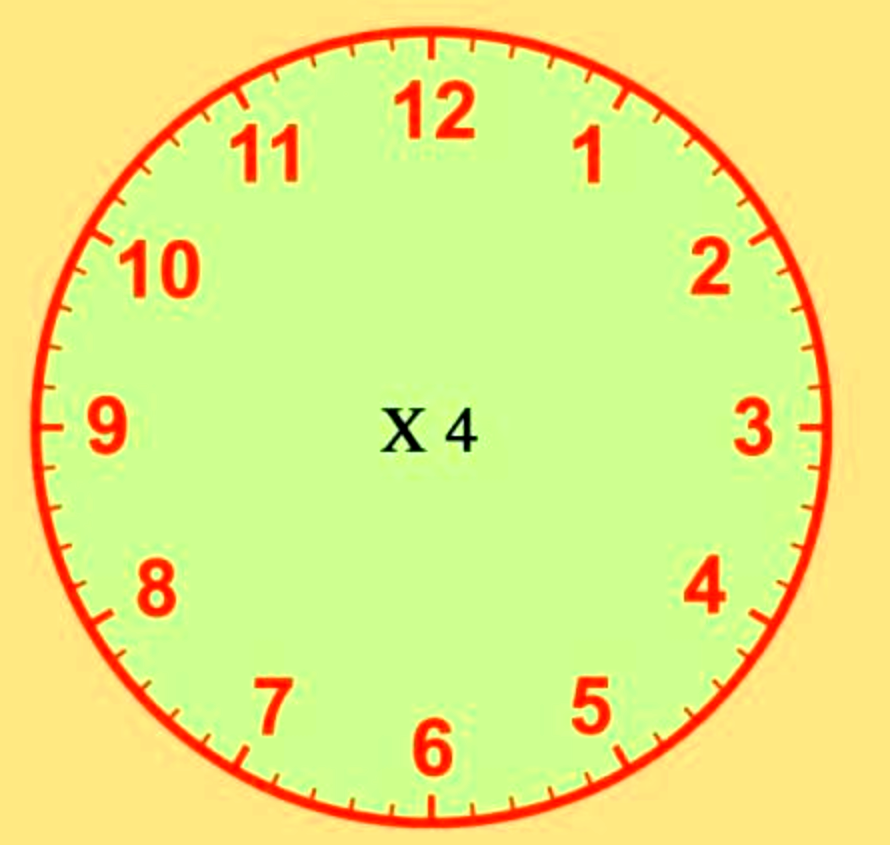
A game I loved from my own school days.
🕐 Draw a basic clock like the one above and label 1–12. Pick a different times table to play with each time, for example, the 4 x table.
🕐 Point to a number on the clock - they multiply it by 4 and say the answer.
🕐 Go in order the first time as a practice, then start mixing it up.
🕐 Speed it up. You can make this really fast - but only once they're confident.
🕐 To increase the challenge, have a go at the inverse. So if you're doing the 4 x tables, call out 28, they'd have to call out 7. (4 x 7 = 28).
The fun part is when they get to test you afterwards!
🚦 Travelling Traffic Light Game

Perfect for car journeys!
How to Play: (Works better collaboratively, not as a competition).
🚦Each colour is a point you all decide on at the start (Red = 1, Orange = 2, Green = 5 etc.)
🚦 If the car drives straight through, it's green, if it has to stop, it's red and it's amber if it changes as you just pass it. (No running the lights to get a higher score though!)
🚦 To increase the challenge, you can:
- Assign higher values to colours.
- Introduce negative numbers for red lights.
- Add bonus points for level crossings and pedestrian crossings.
- Each person guesses what the final score will be at the end of your journey (this works well for journeys you do often). The closest at the end is the winner.
This game can easily be adapted for trains, buses and journeys without many traffic lights. Assign points to other cars, stations, trains, people, animals etc.
Countdown Number Game
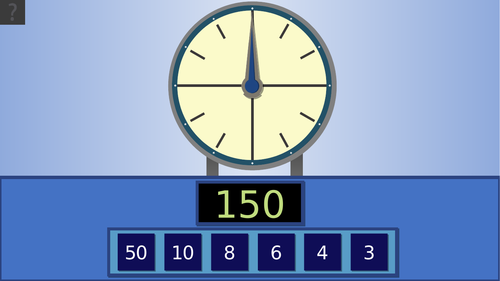
This one can be very easy or really challenging and it's a great one for the whole family to play together. (Try having multiple games on the go for different abilities).
You can play it online but we mostly do it on a whiteboard - sometimes they're really hard so we might leave it and come back to it over the course of the day.
How to play:
➕ Choose up to 6 numbers from 1-9 and any of 10, 25, 50, 75, 100.
➖ Choose a small number for an easier game, or a larger number for a challenge. (It's fine if it's not exact for the harder games, just aim to get close).
✖️ Use the chosen numbers with ➕ ➖ ✖️ ➗ to reach the target. Each number can be used only once, and you don’t have to use them all.
➗ To simplify, use fewer numbers and a small target; to increase difficulty, raise the target.
Let me know how you get on with these at jo@thehomeedhelp.com. And if you have any more quick mental maths games you've found useful, I'd love to hear about them!